Competency F
Selection, evaluation, organization, and preservation of resources
Introduction
Joudrey & Taylor (2018) convey that “organization helps us to make sense of many things in daily life” (p. 2). Furthermore, they continue by saying it helps us understand, save time, group similar things and ideas together, and retrieve the information we seek (p. 2). We must all remember that the user is at the forefront of collection management. Lehman (2013) relays that “ although no library has had sufficient funds to purchase everything it wanted, today’s particular slim budgets mean that librarians must focus on the main principle of basing collection decisions on patron needs” (p. 170). The first part of this is the selection of materials.
Jourdrey and Taylor (2018) explain that selection involves collection development librarians discovering new works via vendors’ catalogs, reviews, announcements from publishers, library user requests, and similar sources. They determine and select the most suitable materials for their collections (p. 12). The Online Dictionary for Library and Information Science (ODLIS) defines selection as “the process of deciding which materials should be added to a library collection. Selection decisions are usually made on the basis of reviews and standard collection development tools by librarians designated as selectors in specific subject areas, based on their interests and fields of specialization” (2013). It also “involves looking for the strengths and weaknesses in an item and how it might or might not match the needs of the collection” (Eduscapes, n.d.). As noted in Eduscapes, Gregory (2011) provides guidelines for library material selection, emphasizing that choices should be suitable for the collection and unbiased, covering a range of viewpoints. Material selection should also meet user needs without exclusion based on the author’s or user’s background or beliefs (n.d.). Once selection takes place, evaluating the material needs to take place.

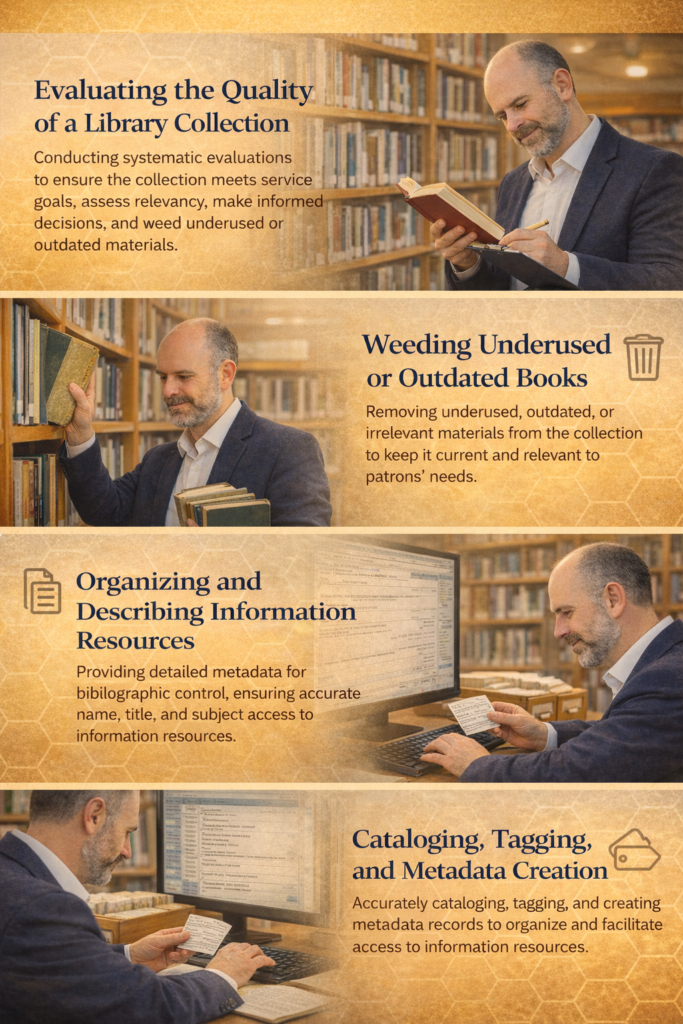
ODLIS (2013) defines collection assessment and evaluation as “the systematic evaluation of the quality of a library collection to determine the extent to which it meets the library’s service goals and objectives and the information needs of its clientele”. The element of weeding plays a significant role in this phase. Lehman (2013) highlights how “weeding physical collections means making a collection more relevant to patrons as they search the shelves and catalog for materials” (p. 174). It’s crucial to emphasize that evaluation is an ongoing process that must not have significant interruptions. Evaluation offers insights into internal operations like budget justification, decision-making, and resource allocation, including digital conversion. Evaluation helps assess if a collection meets its goals, such as strengthening weak areas and enhancing strong ones. It allows for viewing the collection holistically rather than in segments and also aids in assessing vendor performance (Eduscapes, n.d.). Once this process is completed, it leads us to look at information organization.
In their book, Jourdrey and Taylor (2018) say “bibliographic control (more often referred to as information organization today) is the process of describing information resources and providing name, title, and subject access to descriptions, resulting in records or individual metadata statements that serve as surrogates for the actual items of recorded information” (p. 6). Metadata is, in simple terms, data about data. They further explain in their book that the provided descriptions should give users enough information to decide whether a resource is valuable (p.6). Ronald Hagler, as described by Jourdrey & Taylor (2018), outlines six methods for organizing information. These methods involve recognizing all available informational resources and the works within them, and systematically assembling these resources into collections. Additionally, they include creating lists of these resources formatted according to citation rules, detailing names, titles, subjects, and other relevant information, and finally, offering a way to locate these resources (p. 7-11).
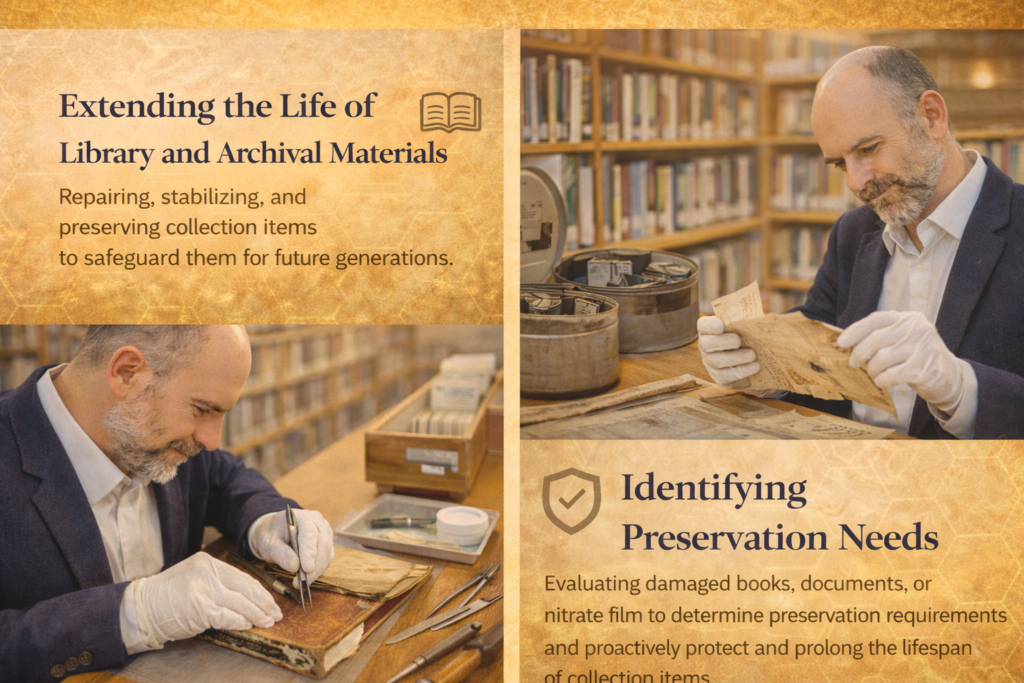
ODLIS (2013) defines preservation as the practice of extending the life of library and archival materials. This is achieved by keeping them in a condition suitable for use, either in their original format or a more durable one. This involves maintaining proper environmental conditions or undertaking restorative actions after damage to prevent further deterioration. Furthermore, film preservation is crucial as nitrate and acetate base films naturally decay. Effective preservation typically involves creating surrogate copies for public use and master copies for future reproductions, reducing wear on the original films. Finally, digital preservation involves maintaining digital materials in a usable state, ensuring both the preservation of the digital data and the ability to access or display the content. The challenge is amplified by the rapid deterioration of some digital storage media and the dependence of digital objects on continually evolving access technologies.
The New Orleans Public Library states that a “Collection Development Policy is designed to support the Library’s mission statement and serves as a guide for the selection, acquisition, maintenance, and retention of materials by
establishing roles, responsibilities, and a process for addressing Library user concerns” (2023). Gregory (2011) emphasizes that an effective policy provides several protections for the library. It upholds intellectual freedom and communicates the library’s strategic direction to its governing or funding bodies. It also offers a clear, well-defined explanation for the library’s collection objectives and procedures, which helps in safeguarding against accusations of bias and misconduct. Furthermore, the policy defends the library from pressures to acquire or provide access to unsuitable or irrelevant resources. It acts as a resource for both library users and the wider community to understand the library’s practices. Additionally, in times of budget cuts or rising material costs, it offers some protection against complaints from the user community (Eduscapes, n.d.).
Evidence
My first artifact to show mastery of competency F came from INFO 202 involving a Database Design – Beta Prototype. My responsibilities involved designing field names and values, developing the data structure and database, and reviewing the final project and documentation. The purpose of this database is to house a collection where individuals with acne and acne-prone skin can search for acne-fighting products available at local Sephora stores. The collection provides various acne treatments that cater to an individual’s specific needs and preferences, e.g., sensitive skin, oily skin, cruelty-free products, sulfate-free products, and serums. The user accessing the database will search for products by search fields such as brand, size, formulation, and price, and refine results based on their search preferences and the type of product for which they are searching. Individuals will be able to search for acne products based on the specific size for which they are looking, a specific formulation such as a face mask or cream, or the ethical attributes of products such as vegan or cruelty-free ingredients. Users will also be able to search based on their price preference as well as by specific brand preferences or by specific skin types, e.g., dry skin or combination skin.
My second artifact comes from INFO 202 and it deals with an evaluation and design of a website. My role involved several key activities: I sought out the website and helped establish the initial sitemap for the current version. I also started providing input and feedback on the new sitemap during discussions and began drafting the summary of the report. Subsequently, I completed the initial summary and drafted the User Testing section. Finally, I edited the document and updated the Table of Contents. Who Gives a SCRAP is a second-hand crafting and art supply store located in Colorado Springs, Colorado. Through donations, the company diverts materials it might otherwise send to the landfill into the hands of artists and crafters who can purchase supplies in good condition at well below typical market rates to reuse and repurpose. Who Gives a SCRAP’s website exists primarily to engage with customers, donors, and sponsors as well as provide locational and activity-focused information. Because the store relies on donations, Who Gives a SCRAP’s constantly changing inventory does not include a website retail store. There are, however, opportunities for individuals to donate directly, purchase gift cards, attend classes and events, and apply for space rentals. Who Gives a SCRAP should redesign its website to communicate with customers, donors, and sponsors more effectively. A visual and organizational redesign would present a more professional image of the company. In addition, the website’s navigation is not currently intuitive due to disjointed top-level menu options and poor text formatting choices. A more user-friendly interface and a more professional visual presentation should allow for better engagement with the company’s target audience.
My final artifact comes from INFO 202 where I had to create structured metadata. for a project. I had to find, analyze, and highlight information for ten socks. I had to create fields and values in a systematic way so that users could search successfully and obtain all the necessary information to properly evaluate different selections. This was the initial exercise of the overall project.
References
Collection development policy. New Orleans Public Library. (2024, April 19). https://nolalibrary.org/policies/collection-development-policy/
Gregory, Vicki L. (2011). Collection Development and Management for 21st Century Collections. Neal-Schuman Publishers, Inc.
Lehman, K. A. (2014). Collection development and management. Library Resources & Technical Services, 58(3), 169–177. https://doi.org/10.5860/lrts.58n3.169
Rietz, J. M. (n.d.). Odlis. ODLIS S. https://odlis.abc-clio.com/odlis_s.html
Selection. Acquisitions and Management of Knowledge and Information. (n.d.). https://eduscapes.com/collection/4.htm#a